
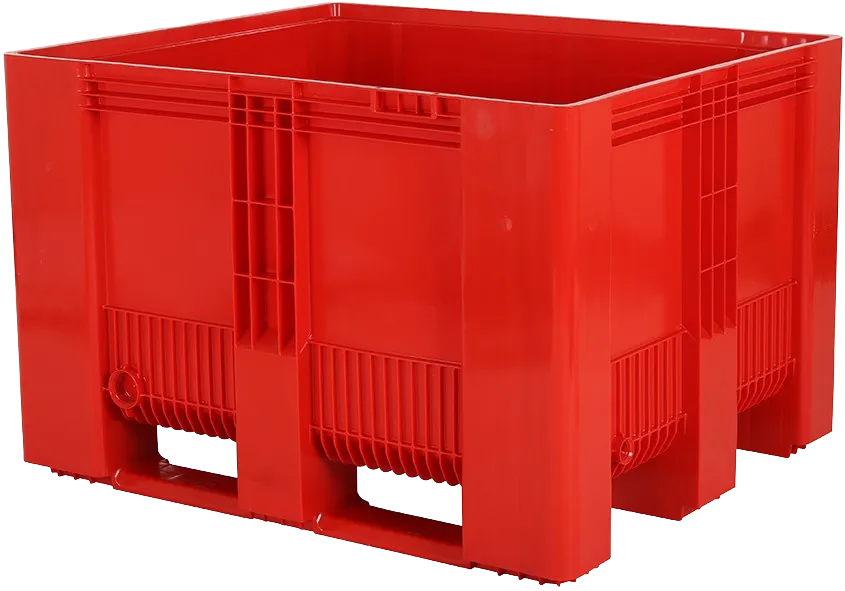
Walk into a working warehouse and pay attention to what is actually holding everything together, and you will find, if you look carefully enough, that industrial stackable storage boxes are doing a great deal of the work. Not the forklifts, not the racking, not the warehouse management software running on a screen in the supervisor’s office. The boxes. The containers sitting in columns, absorbing load, holding position, presenting their contents to whoever needs them. They are unglamorous in the way that good infrastructure is always unglamorous, which is to say, you only really notice them when something goes wrong.
Something going wrong in a warehouse context can mean a fractured base on the third tier of a stack, a column that shifts under a dynamic load and brings down its neighbours, or a container that has absorbed one too many impacts and developed a hairline crack along a corner seam. In Singapore’s logistics and manufacturing sectors, where operations run continuously and floor space carries extraordinary cost, these are not minor inconveniences. The case for understanding durability and load considerations in industrial-grade stackable storage boxes is, at its core, a case for understanding how things fail before they do.
The Material Question
Everything begins with what the box is made of. The dominant materials in quality heavy-duty stackable storage boxes are high-density polyethylene, known as HDPE, and polypropylene. HDPE is tough, resistant to impact, and performs well across a wide temperature range. Polypropylene is stiffer, slightly lighter, and generally more resistant to chemicals and surface abrasion. In practice, both materials appear throughout Singapore’s industrial storage landscape, and the choice between them tends to come down to the specific demands of the application.
What both share is a susceptibility to one particular enemy: sustained ultraviolet exposure combined with heat. Singapore’s equatorial climate accelerates the degradation of polymers that are not properly stabilised. A container that would last fifteen years in a northern European warehouse might show brittleness within five if exposed to direct sunlight and high ambient temperature. It is worth asking, when sourcing stackable industrial storage containers, whether the material specification includes UV stabilisation.
Understanding Load: Static, Dynamic and Stacking
There are three distinct load conditions that any serious industrial stackable box must be evaluated against.
Static load is the weight the container holds when sitting still. A box rated for 50 kilograms of static load will hold that weight indefinitely on a flat, stable surface.
Dynamic load is what happens when the container is moved. Under dynamic conditions, the effective load on a container’s base and walls can briefly exceed the static weight significantly, leading to stress fractures at base corners if the box is regularly dropped or dragged.
Stacking load is arguably the most critical consideration. This is the cumulative weight of all containers above pressing down through the walls and base. The key features of industrial stackable storage boxes designed for high stacking loads include:
Reinforced base geometry
Ribbed or corrugated base structures distribute compressive load across a wider surface area, reducing stress concentration at any single point.
Thickened corner columns
The corners carry disproportionate load. Quality industrial stackable storage boxes reinforce these points specifically.
Interlocking stacking profiles
Precisely engineered ridges engage with the rim of the container below, preventing lateral movement under load.
Consistent wall thickness
Uneven wall thickness creates weak points that manifest under sustained stacking pressure.
What Failure Looks Like, and How to Avoid It
A cracked base corner is usually the first sign that a container has been asked to carry more than it was designed to handle. The crack begins small and propagates under repeated load cycles until the base loses structural integrity.
Preventive practice is straightforward:
- Never exceed the manufacturer’s rated stacking load, which in quality industrial stackable bins is typically printed on the base or side wall
- Inspect containers regularly, particularly those in the lower tiers of high stacks where compressive loads are greatest
- Retire containers showing visible cracks or deformation rather than continuing to use them at reduced capacity
- Ensure stacking surfaces are flat and level, as uneven surfaces create eccentric loading that a container’s geometry is not designed to manage
In Singapore’s logistics hubs, where some facilities operate around the clock and container turnover is high, these inspection disciplines require embedding into standard operating procedure rather than leaving to individual judgement.
The Geometry of Efficiency
There is a satisfaction in watching a well-chosen container system function as it was designed to. The columns rise straight. The loads are distributed evenly. The boxes move through the operation without incident, holding their contents, holding their shape, holding their place in the stack.
Durability and load management are not exciting topics. But they are the foundation on which everything else in a warehouse operation rests, and the facilities that take them seriously are the ones where industrial stackable storage boxes last longer, fail less often, and quietly justify every penny of their cost.